








总 机: 直线 0512-53523886 53521956
E-mail: szts@sbaz.cn, kun@sbaz.cn
地 址: 太仓市城厢镇银川路39号

一.What is an insulated pipe supports and hangers
|
|
|
二.Reasons for using insulated pipe supports and hangers
Pipes transporting hot or cold media are wrapped with thermal‑insulation and cold‑preservation materials to reduce heat dissipation or cold loss on pipe surfaces. However, pipes need to be supported, and support points shall bear the weight of corresponding pipe sections, internal medium, external insulation layer, as well as loads such as wind and snow. Thermal‑insulation and cold‑preservation materials with good thermal performance are lightweight yet feature low compressive strength, and cannot bear the above‑mentioned weight and loads. Therefore, metal pipe supports and hangers are commonly used to directly support and suspend pipes and transfer loads to building structures. These metal supports and hangers in direct contact with pipes become bridges for heat dissipation or cold loss of internal pipe media.
三.Application fields
Airport pipe network |
Underground utility tunnel |
Automotive plant pipe network |
Long‑distance heat network |
Air‑conditioning system |
Nuclear industry system |
四.Insulated vs conventional non‑insulated pipe supports & hangers
1、Comparison between high‑density polyurethane and wooden pipe shoes
| Use high‑density PU insulation blocks | Adopt wood for thermal and cold insulation |
Polyurethane features low thermal conductivity | Wood absorbs moisture easily, which causes mildew, rot and condensation. It also tends to crack when dried under heat. |
Non‑water‑absorbent, resistant to 135 ℃ high temperature and extremely low temperature | Short service life and high maintenance cost |
No mildew formation | Heavy wood consumption is unfavorable to environmental protection. |
Ozone‑depleting gas foaming is eliminated for eco‑friendliness | Wood is low‑priced yet high in operation and maintenance costs. |
Long service life, over 30 years with zero maintenance | Complicated on‑site construction |
Higher selling price, yet cost‑effective in the long run | - |
2、Energy‑saving effect of insulated pipe supports & hangers
Specification(MM) | Heat loss of insulated pipe shoes | Non‑insulated support heat loss | Heat loss difference | Energy‑saving effect (standard coal) | |
W/piece | t/(Year, piece) | t/(Year, piece) | |||
¢219 | 441 | 2103 | 1662 | 1.63 | 163 |
¢273 | 532 | 2622 | 2090 | 2.05 | 205 |
¢325 | 630 | 3150 | 2530 | 2.49 | 249 |
¢377 | 710 | 3621 | 2911 | 2.87 | 287 |
¢426 | 790 | 4092 | 3302 | 3.25 | 325 |
¢529 | 961 | 5081 | 4120 | 4.05 | 405 |
¢630 | 1135 | 6051 | 4916 | 4.83 | 483 |
¢720 | 1286 | 6915 | 5629 | 5.53 | 553 |
Notes: 1. Calculation temperature: 450 ℃; 2. Thermal conductivity: 0.2 W/mK | |||||
五.Reasons and advantages of factory‑fabricated insulated pipe supports & hangers
1.1.The function of pipe supports is to bear pipe loads, restrict pipe displacement, control pipe vibration, and transfer loads to building structures, ensuring safe pipe operation. At present, pipe supports and hangers are regarded as an integral part of piping systems both at home and abroad.
1.2.Since the 1980s, following the practices of industrially‑advanced countries, the manufacturing of pipe supports and hangers in China has shifted from on‑site fabrication to factory‑based production. In 1997, Chinese standard GB/T 117116‑1997 Pipe Supports and Hangers was formulated with reference to American MSS SP‑58, SP‑89 and other relevant standards. Its Part 1 “Technical Specification” specifies in detail the material, design, fabrication, installation, test, inspection, operation and maintenance of pipe supports and hangers.
2.1.Through scientific calculation and design verification tests, the structural design of supports achieves a safety factor of no less than 4.
2.2.Manufacturers implement strict control procedures for quality inspection of raw materials for supports, including steel, thermal‑insulation materials, friction‑reducing stainless‑steel plates and polytetrafluoroethylene (PTFE).
2.3.Mould‑based forming of steel components is adopted by manufacturers to ensure stable dimensions and close fitting with pipes.
2.4.Manufacturers exercise strict control over welding procedures for steel components.
2.5.Professional surface‑treatment plants conduct rigorous substrate preparation prior to coating to guarantee adhesion and quality of paint or zinc coatings.
2.6.Manufacturers establish complete guarantee systems for pre‑sales design services and after‑sales services of products.
Note: On‑site‑fabricated supports and hangers cannot meet the above‑mentioned requirements.
六.Features of taisheng xinlü insulated pipe supports & hangers
1、High safety level:
Our company is a qualified supplier of nuclear‑industry pipe supports and hangers.
2、With standards:
Suzhou Taisheng Xinlü Energy‑Saving & Environmental Protection Technology Co., Ltd.’s insulated pipe supports comply with the building‑industry standard JG/T202‑2007, Polyurethane and Composite Vermiculite Thermal‑Insulation Supports and Hangers for Engineering Pipes.
3、Wide variety:
Except for supports and hangers at elbows, original non‑insulated pipe support components shall all be replaced with insulated pipe supports and hangers. Main types include hangers and supports for horizontal pipes, sliding and guided supports, fixed supports, as well as insulated hangers and supports for vertical pipes.
4、Complete parameters:
Our company’s Technical Selection Manual for Insulated Pipe Supports & Hangers clearly specifies the insulation block thickness, load‑bearing capacity and overall dimensions for various‑diameter pipes and different types of insulated pipe supports & hangers under diverse pipe temperatures, facilitating user selection and engineering layout.
5、Full insulation:
The axial force of insulated fixed supports manufactured by our company is transferred through insulation blocks, completely cutting off the "thermal bridge" for heat loss.
6、Flexible adaptability:
Our company can carry out special design and manufacturing of insulated pipe supports and hangers or equipment supports and hangers according to user requirements.
7、Willing to cooperate:
To reduce heat loss of cold and hot pipes and realize low‑carbon performance during pipeline transportation.
七.Classification of insulated pipe supports & hangers
1、Polyurethane cold‑insulation supports and hangers
Insulated pipe supports and hangers for cold‑preservation of cold pipes and thermal insulation of heating pipes are lined with rigid foamed polyurethane insulation supports between pipes and steel pipe clamps and supports. Its technical indicators are:
Density | 300kg/m³ |
Compressive strength | ≥4.5N/mm² |
Flexural strength | ≥3.5 N/mm² |
Thermal conductivity | ≤0.05W/m.k |
Water absorption | <1.0g/100cm ² |
Oxygen index | ≥30 |
Corrosive element content | Corrosive element content shall meet GB/T17393 |
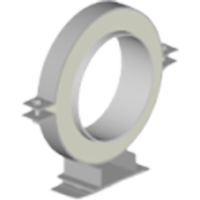
Seat‑type (PU) |
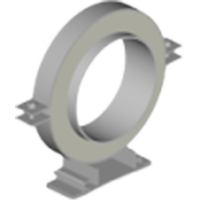
Hanging‑type (PA) |
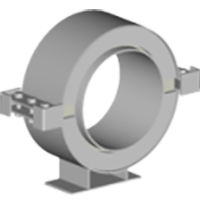
Sliding‑type (PC) |
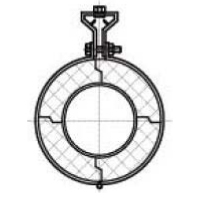
Guide‑type (PD) |
Fixed‑type (PG) |
User Notes:
1.Polyurethane flat pipe support (PB) is mainly applied to scenarios with no restriction on sliding resistance, or where lantern‑type hangers cannot be adopted due to insufficient clearance between pipes and building ceilings, and cross‑arm swing hangers are required.
2.The sliding resistance coefficient of polyurethane flat sliding pipe support (PC) or guide pipe support (PD) shall be less than 0.1.
3.Weld load‑bearing rings on pipes before installing polyurethane flat fixed pipe supports (PG) that bear axial pipe force. The friction between insulation blocks and pipes is insufficient to resist axial thrust of pipes.
4.Polyurethane flat fixed pipe supports cannot bear bending moment and torque loads at pipe supporting‑hanging points. Therefore, both its bending and torsional stiffness shall be set to zero in pipe stress calculation.
5.Rigid foamed polyurethane insulation supports feature low water absorption, so external moisture‑proof and protective layers are generally not provided.
Please specify in the contract if required.If technical parameters fail to meet your requirements, our company will design and manufacture per your specifications.
Polyurethane Compressive Strength Comparison with Peers:
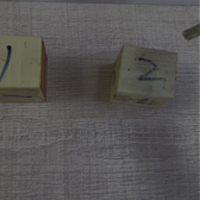
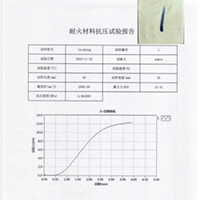
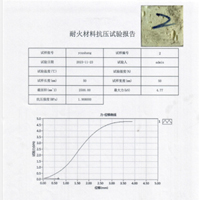
Specimen | Company | Length/mm | Width/mm | Height/mm | Volume/m3 | Density (kg/m3) | Weight/g | Compressive strength (N)N/mm2 | Compressive strength compliance |
1 | Our company | 50 | 50 | 47 | 0.0001175 | 297 | 34.9 | 4.96 | Meet specifications ≥4.5N/mm2 |
2 | Peers | 50 | 50 | 47 | 0.0001175 | 237 | 27.9 | 1.91 | Fail to meet specifications ≥4.5N/mm2 |
|
|
|
2.New Composite Thermal‑Insulation Support & Hanger
Adiabatic pipe supports and hangers for thermal and high‑temperature pipelines are fitted with high‑strength inorganic rigid thermal‑insulation inserts between pipelines and steel pipe clamps/seats. The main material is high‑strength expanded vermiculite. Its technical indicators are as follows:
Compressive strength | ≥4.0N/mm² |
Flexural strength | ≥2.8 N/mm² |
Thermal conductivity | ≤0.2W/m.k |
Moisture content | ≤5% |
Combustion performance | Non‑combustible |
Corrosive element content | Compliant with GB/T17393 "Specification for Thermal Insulation Materials for Covering Austenitic Stainless Steel" |
Operating temperature | ≤700℃ |
Hanging‑type (VA) |
Support bracket(VB) |
Sliding (VC) |
Guiding‑type (VD) |
Fixed‑type(VG) |
User Notes:
1、Horizontal pipe support brackets can be applied to occasions with no limitation on sliding resistance, or where pipelines are supported by swing‑frame cross‑arm hangers, see the right figure.
2、The sliding resistance coefficient of sliding supports and guiding supports shall be less than 0.1.
3、Before installing fixed supports and vertical‑pipe hangers subjected to pipeline axial force, load‑bearing snap rings shall be welded onto the pipeline. The friction force between thermal‑insulation blocks and pipelines is insufficient to resist pipeline axial force! For pipelines operating at ≥400 ℃, the thickness and welding requirements of load‑bearing rings shall be verified according to pipeline material.
4、Adiabatic fixed supports cannot bear bending moment and torque loads at pipeline support‑hanging points. Therefore, both bending stiffness and torsional stiffness of fixed supports shall be set to zero in pipeline stress calculation.
5、If a moisture‑proof layer and protective layer are required outside high‑temperature resistant thermal‑insulation supports, please specify this in the contract.
If the technical parameters fail to meet your requirements, our company will design and manufacture products in accordance with your specifications.
八.Main structural types and operation schematic diagram of adiabatic pipe supports
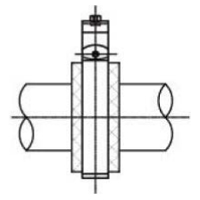
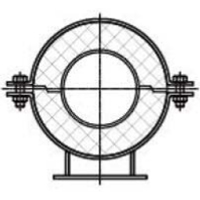
1、Horizontal Pipeline Hanger
Used for hanging horizontal pipelines, adaptable to radial and axial displacement of pipelines.
|
|
2、Horizontal Pipeline Support Bracket
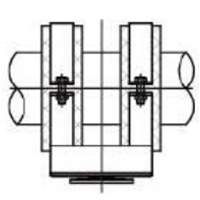
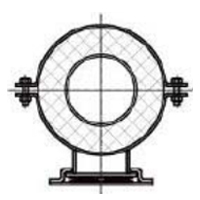
It can be placed directly on platforms yet with high sliding resistance. It can also be mounted on double‑suspended steel beams to accommodate radial and axial displacement of pipelines in a swing‑frame manner.
|
|
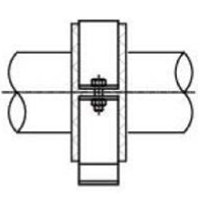
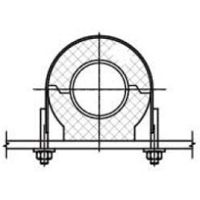
3、Flat‑bottom Cold‑Insulated Support for Horizontal Pipes
This is a simplified cold‑insulated support for horizontal pipelines. It adopts flat‑bottom cold‑insulation blocks with non‑circular cross‑section, which can be directly placed on steel beams and fixed by U‑type pipe clamps. It simplifies the support structure, enables more compact pipeline layout and improves space utilization.
|
|
4、Horizontal Pipe Fixed Support
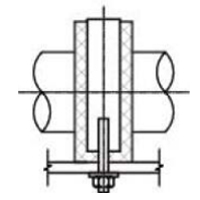
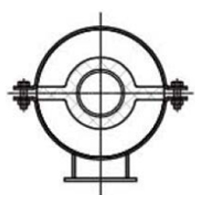
It serves as a key node in pipeline layout, where the pipeline is restricted from axial and radial displacement and acts as the design zero‑point for thermal expansion and contraction of the piping system.
To realize transmission of pipeline axial loads, load‑bearing rings shall be welded onto the pipeline, and load‑bearing sector plates shall also be welded on steel pipe clamps. Pipeline axial force is transferred from load‑bearing rings to cold‑insulation blocks, then to load‑bearing sector plates of the support base, and finally delivered to building structures. This achieves axial load‑bearing performance while breaking cold‑bridge transmission.
Since the compressive strength of polyurethane cold‑insulation blocks is far lower than that of steel supports, the insulation blocks shall only bear uniform compression on flat or curved surfaces rather than localized compressive stress. Accordingly, horizontal pipe fixed supports cannot withstand bending moment and torque. In practical projects, sliding or guiding supports can be arranged on both sides of fixed supports to convert pipeline bending‑moment loads into radial loads.
|
|
5、Horizontal Pipe Sliding Support
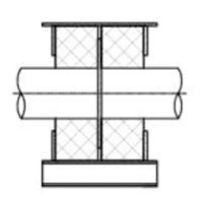
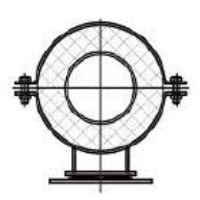
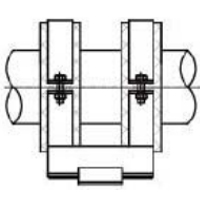
It adopts PTFE‑mirror‑finished stainless steel low‑friction pair on the bottom of horizontal pipe support bracket to reduce movement resistance caused by pipeline thermal expansion and contraction. It mitigates thrust exerted by pipelines on building structures and reduces structural dimension requirements.
The base plate of sliding pair shall be sized larger than the sum of support dimension and sliding travel. Therefore, the axial length of sliding supports is longer than that of ordinary horizontal pipe support brackets.
|
|
6、Horizontal Pipeline Guiding Support
|
|
7、Low‑friction performance with friction coefficient ≤0.1 is achieved by optimizing the fixing mode of PTFE blocks.
|
|
Rivet fixing is adopted for the periphery and central position. |
Fixed by inlaying method |
8、Schematic Diagram of Cold‑Contraction Operation for Adiabatic Pipe Supports